





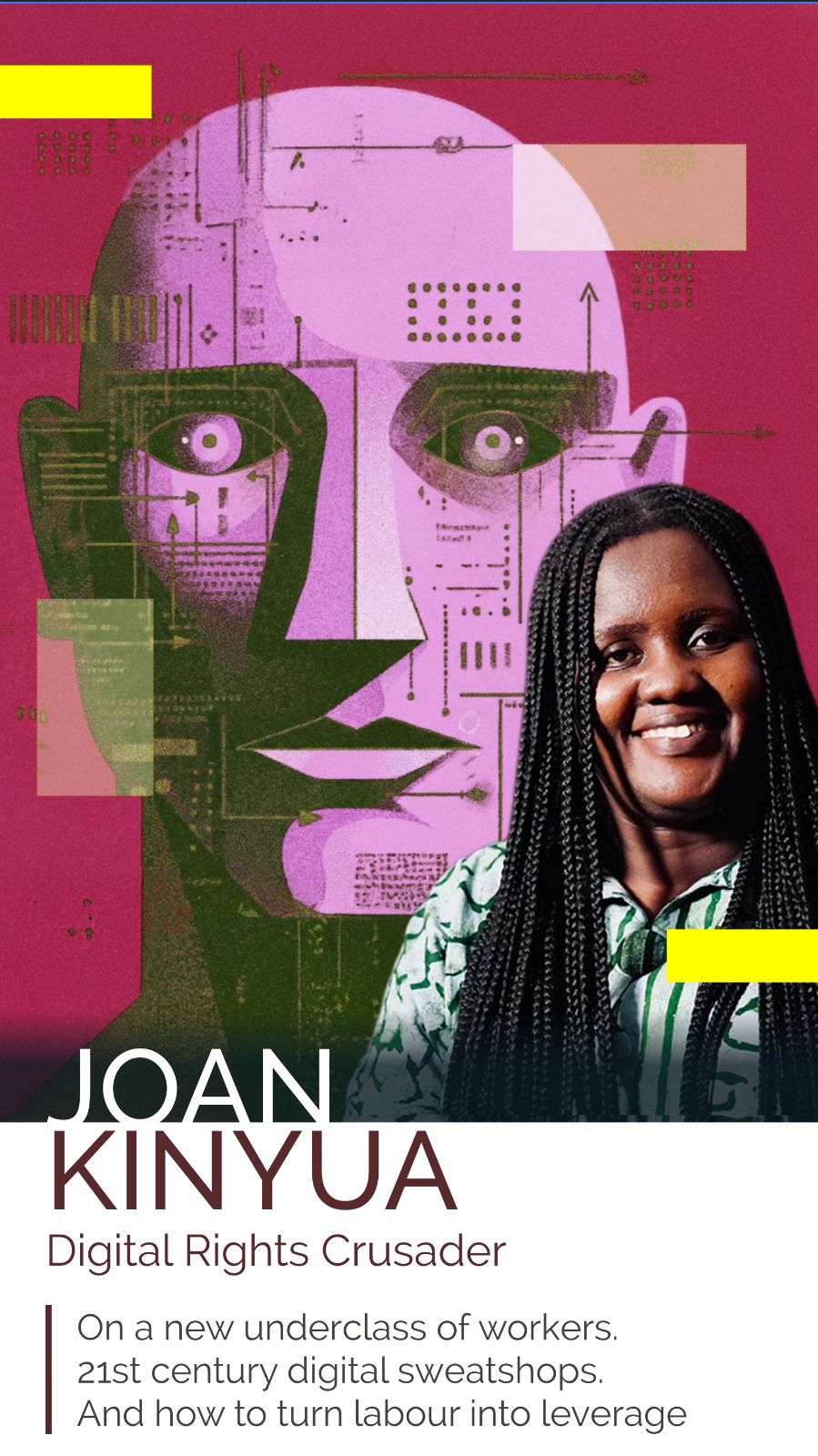

Joan Kinyua
Digital Rights Crusader
WHO SHE IS
-
A digital rights crusader who's championing for the invisible labour behind AI. Asking whether automation is destiny — or a choice disguised as inevitability.
-
Kinyua is the President of the Data Labelers Association, representing the largely invisible workforce that tags, sorts, cleans, moderates, and interprets data so machines can “think.”
-
She insists that data labeling is the foundational infrastructure of intelligence, not peripheral labor, and that labelling is co-intelligence— humans and machines thinking together, but unequally valued.
THE HIDDEN FRONTIER OF DATA LABOR
-
Kinuya challenges the Silicon Valley opinion that AI is autonomous or self-made, insisting that intelligence is social, cultural, and human before it is technical.
-
Data labelers interpret context, culture, language, and ethics— not just click boxes. They absorb disturbing content (violence, abuse, hate speech, trauma) so the public does not have to. They function as the emotional firewall of the digital world.
-
But much of this labor remains outsourced, precarious, and underpaid. While most of these workers are accumulated in the Global South, the profits get accumulated in the Global North.
-
Kinyau is reframing AI as a labor system disguised as technology, not a purely technical breakthrough.
Kinyua advocates for:
-
Fair pay
-
Mental health protections
-
Transparent working conditions
-
Collective bargaining
-
Professional recognition of labeling as skilled work
THE BURNING QUESTIONS
-
If AI is built on human data labor, who truly owns intelligence? The companies? The coders? Or the workers who teach machines what the world means?
-
Is it ethical to profit billions from systems trained on underpaid workers in the Global South? And if these systems automate white-collar jobs tomorrow, what obligations do tech firms owe to the very people who made that automation possible?
-
There is also the question of dignity. When human judgment becomes a dataset, does it erase the person behind it? Or can labeling be reimagined as skilled cognitive work rather than digital drudgery?
-
Kinyua pushes further still: If AI becomes more powerful, will labelers become obsolete — or will their role evolve into guardians of meaning, bias, and ethics in machine systems?
-
And perhaps the most radical question: Could data workers one day claim collective ownership over the models they helped create?
AT SYNAPSE
Kinuya will take us inside the lives of data labelers, the political economy of platforms, and the power struggles shaping the future of work. And ask an unsettling question: If machines learn from us, who is responsible for what they become? And if AI remakes the world— will it do so with its workers, or at their expense?


