





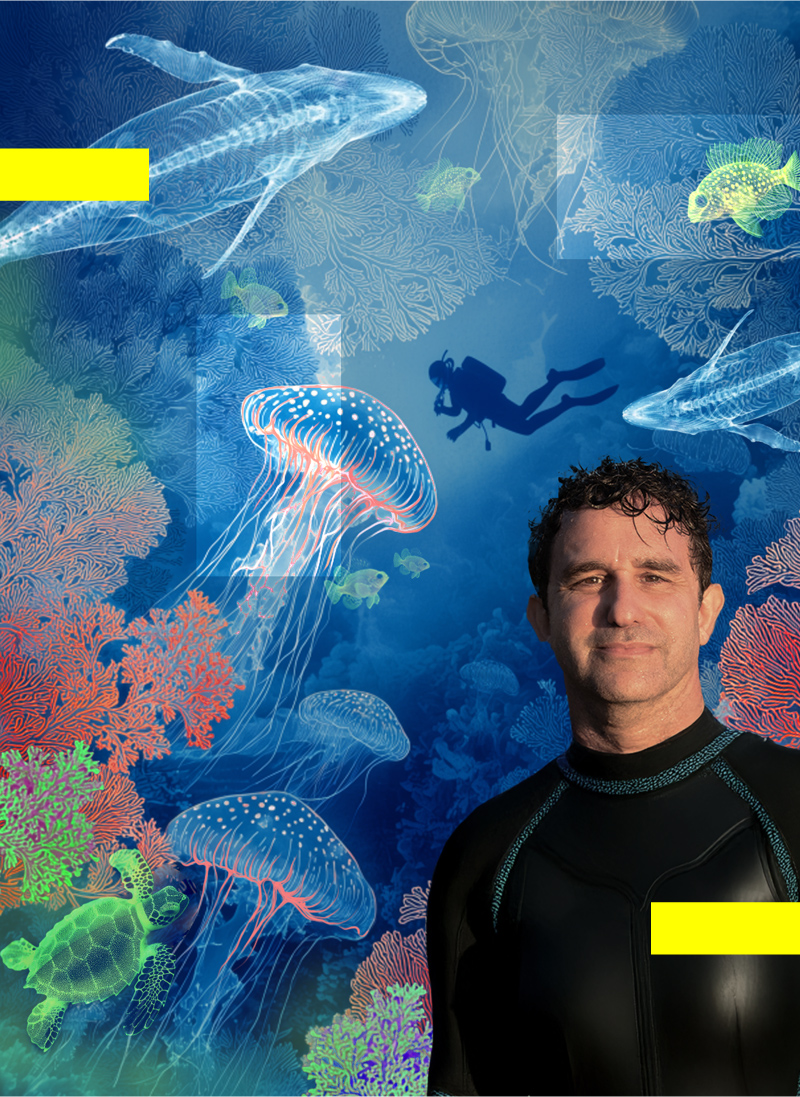

David Gruber
Sea Sleuth
On AI and secrets of the sea. Speaking with whales, seeing like sharks. And the oceans immense technology
WHO HE IS
-
Discoverer of a hidden universe of deep-sea fluorescence. A phenomenon where sea life absorbs light – and emits it back in greens, oranges, reds.
-
A marine biologist who’s invented “gentle robots” – soft, flexible tools that interact with life without harming it.
-
An adventurer, a National Geographic Explorer, and a “radical empathizer”. Gruber doesn’t just study nature. He
-
Founder and President of Project CETI – the audacious non-profit venture to listen and decode sperm whale speak. And they’ve just
AN UNDERSEA DISCO PARTY
-
He and his team were the first to document biofluorescence across some 200 marine species. Sea turtles. Scorpion fish. Seahorses. Stingrays. He’s even spotted a neon swell shark.
-
Apparently, fish have had the ability to fluoresce for over 100 million years.
-
On the one hand is the sheer beauty – and marvel – of these glow-in-the-dark creatures. Another magnificent example of Nature’s technology.
-
On the other, potential medical and experimental uses of this phenomenon. For example, a molecule based on the chemistry of a glowing green eel that can spot certain compounds in our blood – and their elevated levels, which are dangerous.
AN ARSENAL OF ULTRA-SOFT ROBOTICS. AND EMPATHY TECH
-
For too long, studying the natural world has meant intrusion. Damage. But Gruber is retooling science – by designing tools that adapt to sea life as they are, not as we are.
-
Like a 3D printed robotic claw that embraces delicate jellyfish at 1/10th the pressure that the eyelid rests on the eyeball. Because even jellyfish – primitive, 500 million years old jellyfish – experience stress. Or origami-inspired “squish robot fingers” that leave very light fingerprints on the sea life they touch.
-
He’s also been instrumental in inventing tools that subvert the gaze. Like the “shark-eye” camera – that sees the ocean from a shark’s perspective.
-
Gruber is convinced – care matters. Deep, long-term human observation matters. Gentleness matters. He’s using tech to engineer empathy – to connect us to life beyond our own selves. He calls it “subversive empathy building”, an ideology he’s taken forward into his latest venture, Project CETI.
A BOLD PROJECT. AND A PARADIGM SHIFT
-
Project CETI – and its human pod of marine biologists, linguists, acousticians, cryptographers, computer scientists, roboticists – have been diving deep into the Caribbean to record the clicks and codas of sperm while. And decode them.
-
20 years’ worth of recordings from 400 sperm whales have revealed that sperm whales have “accents”. “Dialects”. And a phonetic “alphabet” – which means that their click patterns aren’t random. But have meaning. Context. All thanks to AI.
-
More recently yet, an AI model trained to make music is learning to translate sperm whale clicks into human speech – and vice versa. The intention is to teach it to speak sperm whale. Finally understand another species. Bridge the human non-human barrier. Reorient ourselves in the larger web of life – and reap benefits across climate action and conservation. Tall ask from an AI model that is currently producing clicks with no meaning? Maybe. But Gruber believes WhAM is like an early internet browser – crude, but a paradigm shift.
-
Fun fact: CETI scientists witnessed the birth of a sperm whale up close and personal in 2023 – the first such record since 1986.
AT SYNAPSE
David Gruber will take us deep diving into the ocean – where some sea creatures are as old as 18,000 years. He will reveal the power and wonder of undersea life, how he’s using tech to build empathy and drive up public opinion around its protection. And how he’s using AI to push the frontier of animal language.


