





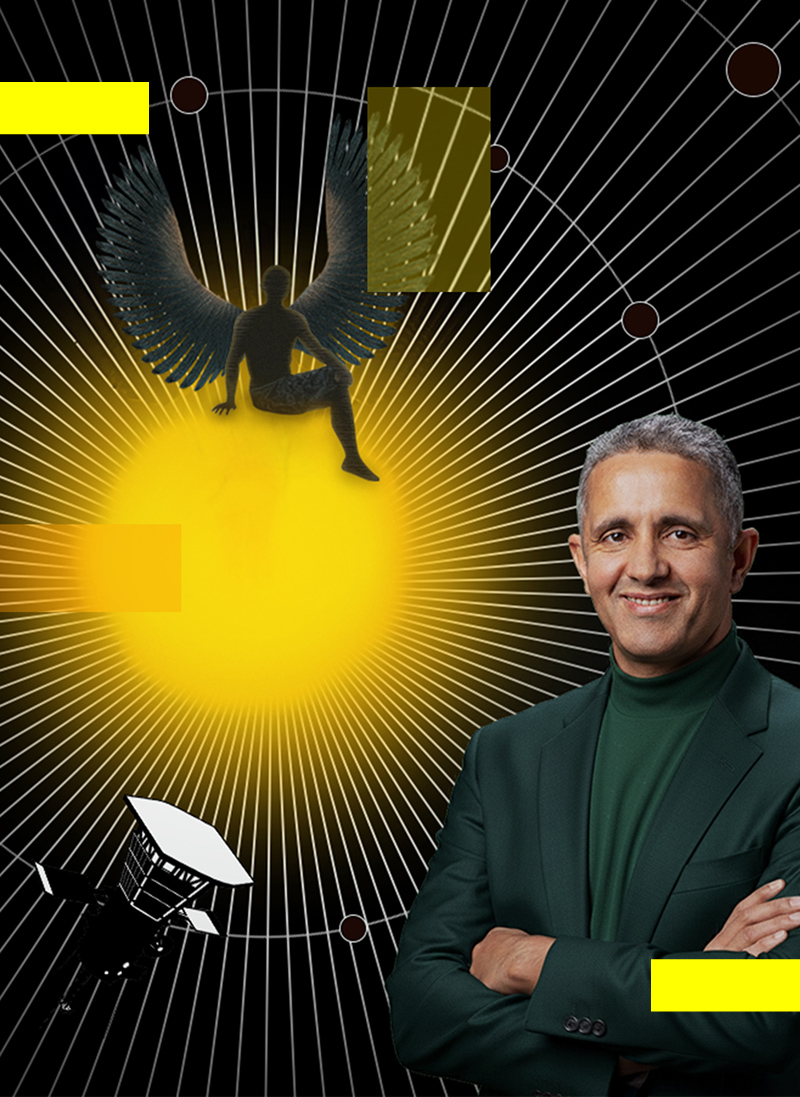

Nour Rawafi
Icarus Reinvented
On NASA's jaw drop solar probe. The awe of 'touching the sun'. And the science of how we got there
WHO HE IS
-
A NASA astrophysicist helping run the Parker Solar Probe — the most audacious space mission ever launched. A spacecraft sent straight into the Sun’s atmosphere in 2018. Not around in – but right into its outer atmosphere.
-
Why? To answer the biggest questions in solar physics: how the Sun works — what drives solar activity, solar wind, space weather? – and how it shapes life on Earth. Its instruments are sampling plasma, particles, and magnetic fields in real time.
-
Fun fact: the mission is named Eugene Parker, the father of heliophysics, the science of sun-solar system connections. He’s the physicist who first proposed the idea of solar wind, roundly criticised in the 1950s until he was proven right. And at age 91, he lived to see the launch of his namesake spacecraft – the first person to ever do so.
THE BIG MYSTERY
-
The Sun is a paradox: Its surface is about 5,500°C. But its corona, i.e., outer atmosphere, is millions of degrees hotter. That’s like walking away from a campfire and suddenly feeling much hotter. Physics said this shouldn’t be possible.
-
For decades, scientists had theories. No proof. No measurements. No way to get close to the entity that literally powers life everywhere.
-
Until Parker Solar Probe — and Rawafi.
THE MILESTONE MOMENT
-
In 2021, Parker Solar Probe officially entered the Sun’s corona — the outer atmosphere of the Sun. This was the first time in human history that a spacecraft crossed the boundary between space and a star.
-
In Rawafi’s words: “We touched the Sun.” Not metaphorically – but physically. Scientifically.
THE JAWDROP SCIENCE OF HOW WE GOT TO THE SUN
-
The Parker probe is the fastest object ever built on earth – flying 7x closer to the sun than ever before.
-
It’s surviving temperatures above 1,300°C, radiation that would fry ordinary electronics, and solar winds moving faster than 700,000 km/h.
-
It’s surfing through exploding magnetic fields.
-
All thanks to a carbon-composite heat shield, 11.4 cm thick. The most advanced thermal protection system ever flown.
-
Its flight path used Venus gravity assists — seven of them — to slowly spiral inward.
-
Rawafi’s role isn’t just scientific. It’s orchestral. He aligns engineers, mission planners, and theorists, ensuring that every terrifying close pass produces clean, usable data. This is not astronomy from afar. This is in-situ star science.
WHY THE MISSION MATTERS (TO YOU)
-
The Sun isn’t just a glowing ball. It’s a volatile engine.
-
Solar storms can knock out satellites. Cripple GPS and communications. Disrupt power grids. Threaten astronauts. And cost the global economy trillions.
-
Understanding the Sun means predicting space weather — and protecting modern civilization.
-
Rawafi often emphasizes this point: we don’t study the Sun for curiosity alone — we study it for survival.
AT SYNAPSE
Nour Rawafi will take you inside humanity’s boldest scientific gamble. Share what it takes to send a spacecraft into a star. What we’ve learned by touching the Sun. How centuries-old mysteries collapsed once we dared to get close enough. And why space science today isn’t about distant galaxies, but about understanding the forces that quietly govern life on Earth.


