





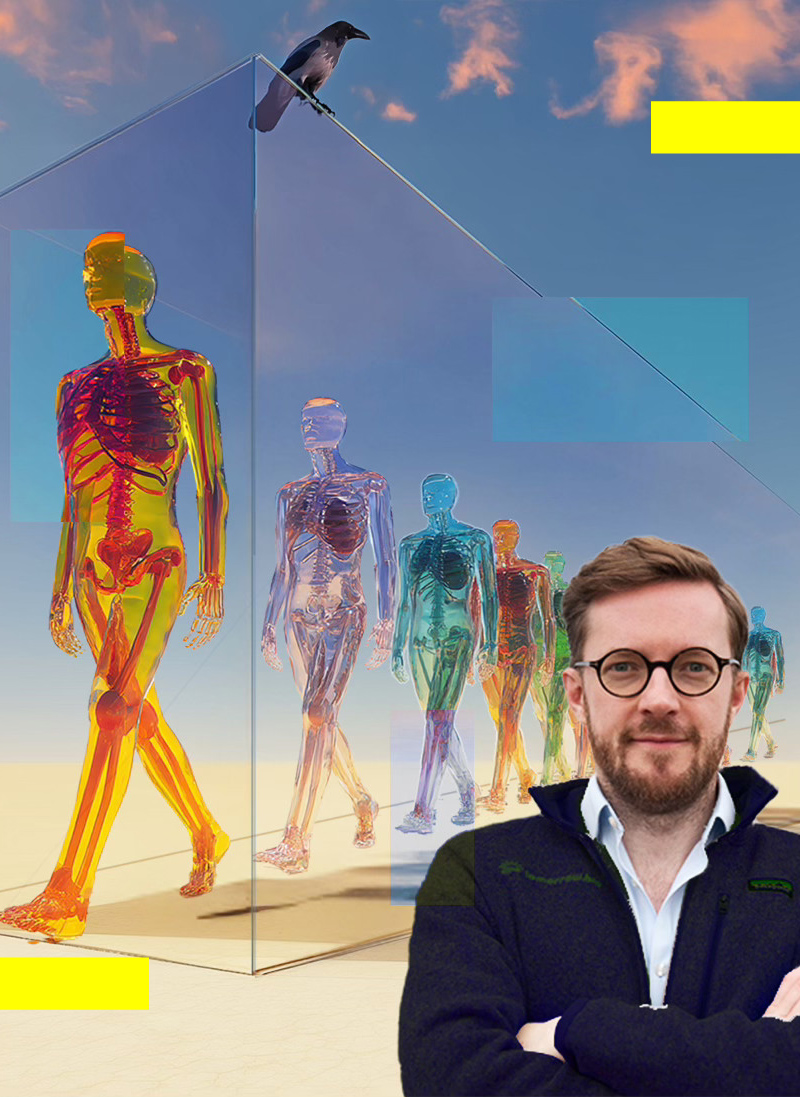


Emil Kendziorra
Immortality Hacker
On challenging time and death. Deferring life - for future revival. And the frontier science of cryonics
WHO HE IS
-
A radical preservationist of human life. A biotech entrepreneur working at the intersection of transhumanism, frontier sciences and the quest to make death optional. An entrepreneur working at the frontier where life meets entropy. Asking if death is a hard stop, or simply a problem we have not yet solved.
-
He is the founder of Tomorrow Bio, one of Europe’s first cryonics companies, building infrastructure to preserve the human brain and body beyond medical death, with the aim of future revival.
-
Cryonics, as he frames it, is not about immortality. It is about time. Buying time for other sciences like neuroscience, nanotechnology, and regenerative medicine to catch up. Tomorrow Bio has cryopreserved 20 people and 10 pets to date and has 800+ members across more than 45 countries signed up.
THE FROZEN FRONTIER OF LONGEVITY
-
Modern medicine declares death when the brain irreversibly loses function. Kendziorra is challenging that assumption. By preserving neural architecture at the moment it would otherwise decay, he treats the brain not as a sacred mystery, but as an extraordinarily biological record. One that future technologies may be able to read, repair, and restart.
-
Cryonics preserves the structure of the brain at ultra-low temperatures. Halting decay before information is lost. i.e memories, identity, personality, the physical patterns that make a person a personality.
-
This is medicine in suspension, in waiting. Biology paused. If identity is encoded in physical structure - the body and the brain - then preserving that constitution makes revival a function of when, not if.
-
Kendziorra’s work focuses on building rigorous medical protocols, rapid response systems, and ethical frameworks — transforming cryonics from fringe speculation into a disciplined, science-aligned practice.
-
This reframes survival itself. Not as continuous consciousness, but as the continuity of information. A wager placed on future medicine and practices by people who refuse to accept that today’s limits must define tomorrow’s outcomes.
THE BURNING QUESTIONS
-
Freezing human beings raises unavoidable questions. Is it ethical to preserve someone without guaranteeing revival? Without the technologies to safely thaw a human back to life, does cryonics even serve a purpose?
-
To add to that, the cost itself is debatable. Tomorrow Bio’s services, for example, cost anywhere between $ 80,000-220,000. Who then gets access? Does this privilege the wealthy or does it pioneer tools that can be universalised?
-
Kendziorra argues that refusing to try is itself an ethical choice. Every medical advance began as an uncertain intervention. To deny patients their last chance because success is not yet proven, he claims, is to confuse caution with moral clarity.
-
There are deeper questions still. If revival becomes possible, who decides ‘how’ someone returns? Into what legal system? What society? What obligations do the living owe the preserved? The list is endless.
AT SYNAPSE
Emil Kendziorra will take us inside a world where medicine no longer ends at the moment of death, and reveal how cryonics challenges our assumptions about life, identity, and finality. He will unpack how biology, neuroscience, and engineering are converging to make preservation possible. And pose the question at the heart of it all: Is death a biological destination or a technical problem we can solve? More importantly, should we?


