





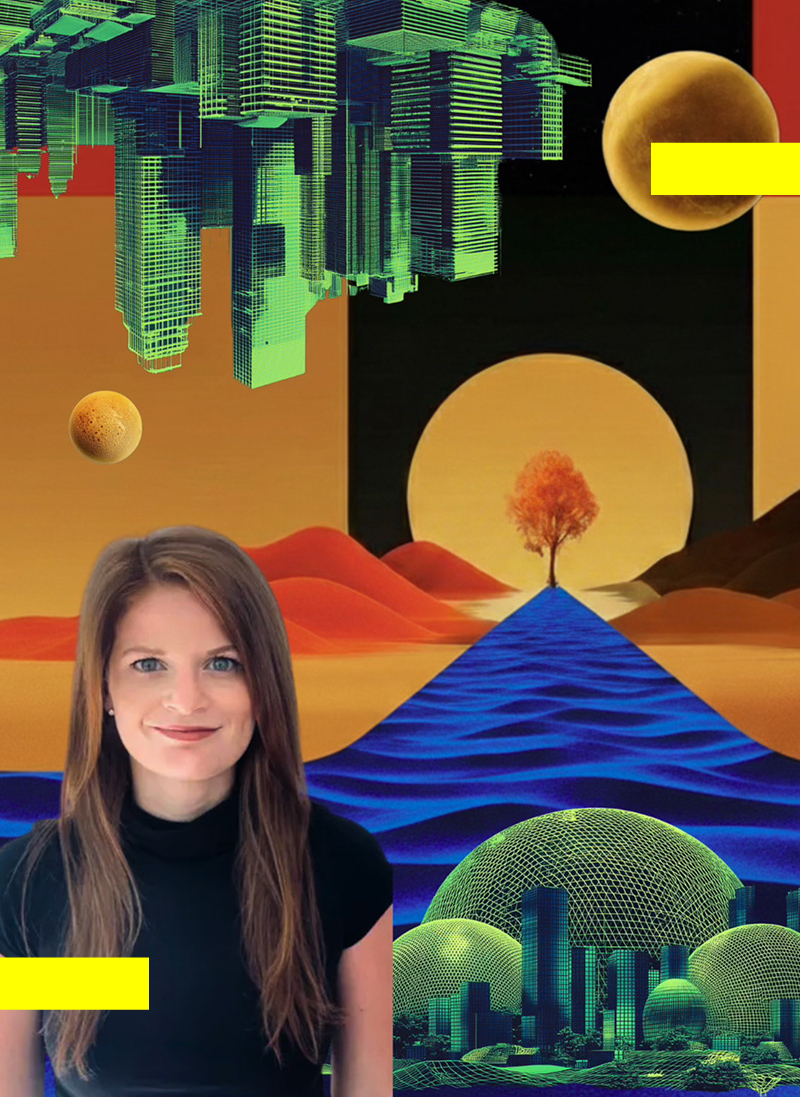

Alana Goldweit
Architect of the Impossible
On building a city on the moon. Its lessons for architecture on earth. And adapting for extreme landscapes
WHO SHE IS
-
An architect of futures at planetary scale. A partner at the Bjarke Ingels Group (BIG) working at the frontier where architecture, systems design, and speculative realism meet.
-
Goldweit approaches design with the notion that buildings are no longer objects, but operating systems. Tangible responses to cities, climates, societies, and even civilizations yet to come. It’s the radical act of asking: what should human habitats look like when we design not just for today, but for centuries, other planets, and entirely new forms of life?
-
At BIG, she has been deeply involved in some of the studio’s most ambitious projects—Olympus, Telosa, and Mars Science City. Ambitious ideas that stretch architecture beyond Earth-bound learnings and limitations. These are not utopias of abstraction. They are rigorously modeled environments shaped by climate data, resource cycles, governance structures, behavior and most importantly, the human instinct for survival.
-
Goldweit belongs to a new generation of designers treating architecture less as a static form, an art that freezes time and more as an adaptive framework to define the future of humanity.
EARTH 2.0
-
Cities were once built to shelter us from nature. Goldweit’s work assumes a paradigm: that future cities must collaborate with planetary systems, not compete with them.
-
Telosa, for example, imagines a new American city from scratch—one million residents organized around walkability, renewable energy, circular resource flows, and a novel civic framework called ‘Equitism’. It’s a groundbreaking attempt at encoding social equity directly into land use, mobility, and governance.
-
Olympus scales the question further. A first-of-its kind lunar city that is set to re-imagine habitats, survival on a foreign body and the next step towards becoming an inter-planetary civilization.
-
Then there is Mars Science City. Not a sci-fi fantasy, but a full-scale terrestrial simulation of extraterrestrial living, located outside Dubai. Here, architecture becomes a survival interface, a testing site for how humans might live, work, and remain psychologically intact on another planet. The first step before we make the shift to Mars.
-
In Goldweit’s work, architecture isn’t just the background. It becomes an experimental system, where human behavior, technology, and environment co-evolve and collaborate in real time.
THE BURNING QUESTIONS
-
Designing cities of the future raises the same uncomfortable questions: who decides what a “good” city is? Who benefits when a city is optimized? Who is included—and who is quietly excluded?
-
Goldweit argues that as architecture gains the power to shape climate outcomes, social mobility, and planetary expansion, design ethics must mature alongside technical capability. Because the stakes are no longer aesthetic. They are civilizational.
-
But a larger question remains. If we can design cities from zero, should we? Who decides access, citizenship, rights - a centuries’ old dilemma? Moreover, if we can build off-world habitats, who gets to leave Earth? Where does design end and governance begin? The built environment, like the natural one after all, shapes identity, agency, and opportunity.
AT SYNAPSE
Alana Goldweit will take us inside architecture’s most speculative laboratory: where cities are prototyped, planets are birthed, and the future is treated as a design problem rather than a fate we must meet. She will unravel how architecture is shifting from structures to systems and pose the defining question of our era - what will Earth 2.0 look like? Will it even be on Earth?


